For a lot of Midtown professionals, acupuncture is the treatment they try last — and then wish they'd tried first. They've cycled through pain relievers that dull the edge without fixing anything, muscle relaxers that leave them foggy at work, and the vague advice to "manage stress" with no real tool to do it. Acupuncture is a legitimate, evidence-informed option for exactly the problems that pile up in a high-pressure NYC workweek: a stiff neck, an aching low back, tension headaches, and a nervous system stuck in overdrive.
At Manhattan Spine & Rehabilitation, acupuncture is one of the services we offer alongside chiropractic and physical therapy — and part of why it works so well here is that it isn't used in isolation. Here's what it actually does, what it helps, and how we use it.
What acupuncture actually does
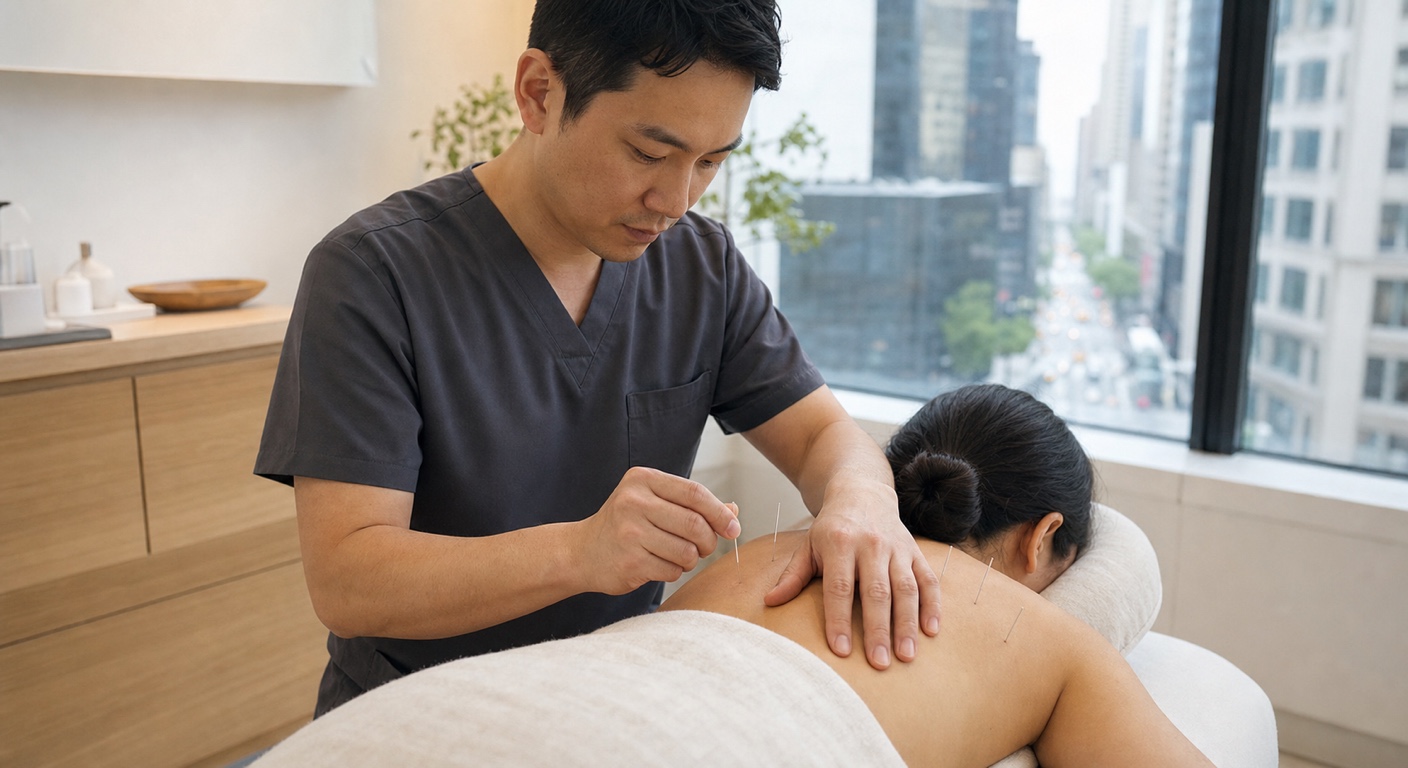
Acupuncture involves placing very fine, sterile, single-use needles at specific points in the body. They're far thinner than the needles most people picture — closer to a hair than a hypodermic — and most patients are surprised by how little they feel. Once placed, they're typically left in for around 15 to 25 minutes while you rest.
From a physiological standpoint, that stimulation appears to do several useful things: it prompts the release of the body's own pain-modulating chemicals (including endorphins), it can reduce muscle tone in tight, guarding muscles, it improves local blood flow to the treated tissue, and it helps shift the nervous system out of a fight-or-flight state and toward the "rest and recover" mode that healing requires. That last effect is a big part of why so many patients describe the session itself as deeply relaxing — a lot of people fall asleep on the table.
What Midtown professionals come in for
The conditions we most often treat with acupuncture line up almost exactly with the wear-and-tear of NYC work life:
- Neck and shoulder tension — the classic desk-and-screen pattern, often with a knot that sits between the shoulder blade and spine and won't let go. Acupuncture releases that guarding muscle in a way stretching alone often can't.
- Low back pain — especially the tight, achy, "I've been sitting all day" kind that flares on the commute home.
- Tension and cervicogenic headaches — a strong fit, since these headaches are driven by muscular tension and stress, both of which acupuncture directly targets.
- Stress, poor sleep, and burnout — the down-regulating effect on the nervous system helps patients who feel wired, can't wind down at night, and carry their stress in their body.
- Sciatica and nerve-related pain — as part of a broader plan, acupuncture can help calm the surrounding muscular irritation that often accompanies nerve pain.
Why we combine it with chiropractic and PT
Here's the distinction that matters. On its own, acupuncture is excellent at calming pain and tension. But if the reason your neck keeps seizing up is a mechanical one — a restricted joint, a weak postural chain, a movement pattern that reloads the same tissue every day — then relief without correction is temporary. You'll feel great for a few days and then be back where you started.
That's why, at Manhattan Spine & Rehabilitation, acupuncture is one instrument in a coordinated plan rather than a stand-alone fix. A typical approach might use acupuncture and massage to calm the pain and muscle guarding quickly, chiropractic care to restore the joint mechanics driving the problem, and physical therapy to rebuild the strength and posture that keep it from returning. The acupuncture makes the corrective work more comfortable and effective; the corrective work makes the acupuncture results last. Everything happens under one roof, which for a Midtown schedule means one appointment instead of three across the city.
What a first session is like
Your first visit starts with an evaluation — your history, what's bothering you, and a physical exam — so treatment is matched to what's actually going on, not a one-size protocol. During the session you'll rest comfortably while the needles are placed; most people feel a brief, mild sensation at insertion and then nothing but relaxation. Afterward, some patients feel immediate relief, others notice it over the next day or two, and mild temporary soreness or fatigue is normal and passes quickly. Because each of us responds differently, we'll talk honestly about how many sessions a condition like yours typically needs rather than selling an open-ended package.
Is it safe?
Performed by a trained, licensed practitioner with sterile single-use needles, acupuncture has a strong safety profile, and side effects are usually limited to minor, short-lived soreness or a small bruise at a needle site. As with any care, tell us about medications (especially blood thinners), pregnancy, or a pacemaker so we can tailor the treatment appropriately. If your pain is from a cause that needs a different kind of workup, our multi-disciplinary team can catch that and route you correctly — another advantage of getting acupuncture inside a full rehab practice rather than a stand-alone storefront.
A drug-free option, steps from the train
If you've been reaching for pain relievers to get through the week, or you carry your stress as a permanently tight neck and back, acupuncture is worth a real try — and it fits a Midtown day. Both of our locations are steps from the subway, and many patients schedule around work or over a lunch hour.
Herald Square (38 W 32nd St, Suite 501) and Grand Central (265 Madison Ave, 2nd Floor) — both steps from the subway.