You notice it first thing in the morning. That first step out of bed lands, and a sharp stab shoots through your heel. It loosens up after a few minutes of walking, so you forget about it — until you stand up from your desk at 3 p.m., or step off the train at Grand Central after a long day, and it is back.
Foot and heel pain is one of the more under-treated complaints we see in Midtown, and there is a reason for that: New Yorkers walk. A lot. People here walk far more than they would in a car-dependent city, and they do it on concrete, in stairwells, and frequently in shoes chosen for the office rather than the mileage.
Why this city is hard on feet
The foot is a load-management system. Twenty-six bones, thirty-plus joints, and a thick band of tissue along the bottom called the plantar fascia that acts like a spring with every step. It is built to handle enormous cumulative load — as long as the demand and the tissue's capacity stay in balance.
Midtown quietly tilts that balance:
- Concrete does not give. Every step returns force that softer ground would absorb. Multiply that by a few thousand steps a day.
- Subway stairs. Stair descent loads the foot and Achilles far harder than flat walking, and no one takes the stairs at Penn Station slowly.
- Office shoes. Dress shoes and flats are usually chosen for the room, not the commute. Worn-out cushioning and a stiff or unsupportive sole change how the foot loads with every stride.
- The all-or-nothing week. Eight hours seated at a desk, bracketed by hard walking. The tissue never adapts to steady demand — it gets shocked twice a day.
- Weekend spikes. A long walk through the park or a day out on your feet, after five days of sitting, is the exact demand jump that irritates tissue.
The morning-pain signature
The pattern is telling, and it is worth understanding, because it is the thing most people misread.
Overnight, the fascia shortens while your foot is relaxed. That first morning step suddenly stretches it, and it protests. Walk for a few minutes and it loosens, the pain fades, and you conclude it is getting better.
It is not getting better. It is warming up. That distinction matters, because the pain fading after a few steps is exactly what convinces people to do nothing for six months — and heel pain that has been present for six months is a considerably harder problem than heel pain that has been present for three weeks.
It is not always plantar fasciitis
Plantar fasciitis is the most common cause of heel pain, but the label gets applied to almost anything below the ankle, and that is a problem when the treatment differs:
- Achilles tendinopathy — pain at the back of the heel rather than underneath, often worse on stairs and after a run.
- Fat pad irritation — the heel's natural cushion, aggravated by hard surfaces. Feels deep and bruised, centrally under the heel.
- Nerve entrapment — burning, tingling, or numbness rather than a mechanical stab. Different problem entirely.
- Stress reaction or fracture — pain that worsens the more you walk and does not warm up. This one deserves prompt evaluation, especially after a jump in mileage.
- Referred pain — foot symptoms driven from the low back or a nerve above the ankle. Uncommon, but we screen for it, because treating the foot will not fix it.
Getting this right at the start is the difference between a plan that works and months of stretching something that was never the problem.
Why rest and inserts alone tend to disappoint
The standard self-treatment is rest, ice, and a drugstore insert. Each of those has a role, and none of them rebuilds tissue.
Rest lowers the irritation, but the fascia and calf do not get any better at handling load while you are off them — so the day you return to a normal Midtown week, the demand is unchanged and the tissue is, if anything, less prepared. An insert can change how load is distributed, which sometimes helps, but it is a redistribution, not a repair.
The tissue changes in response to the right load, applied deliberately and progressed over time. That is the part that makes relief hold, and it is the part a shoe insert cannot do for you.
How our team approaches foot and heel pain
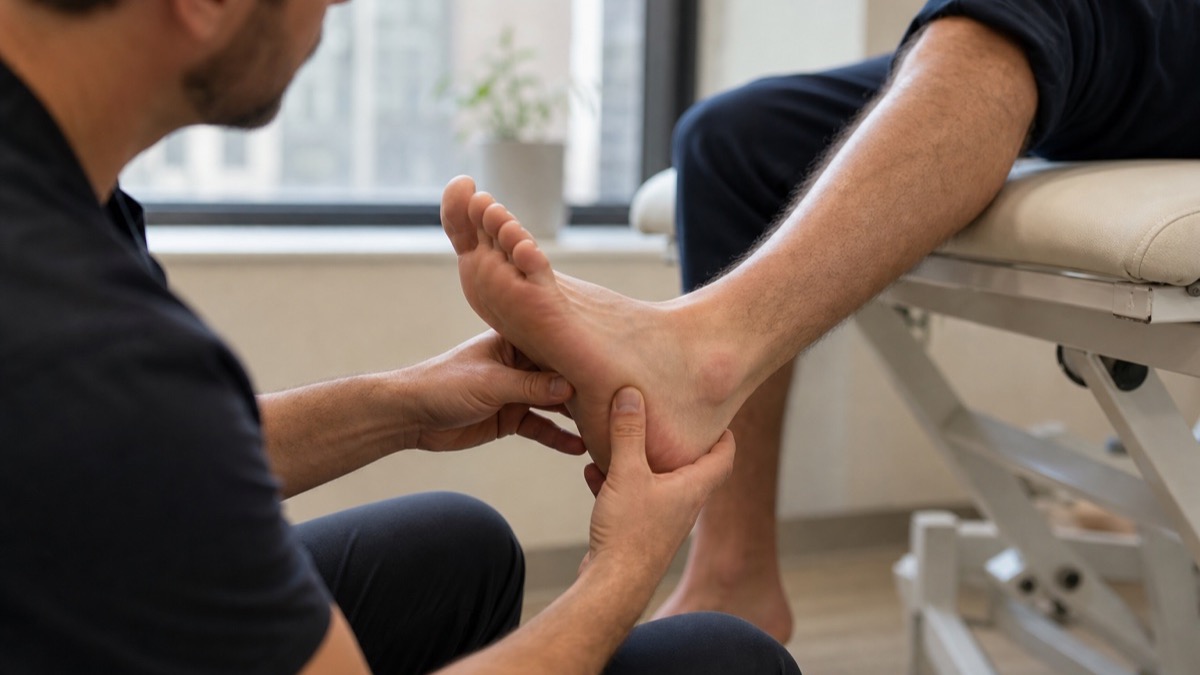
We start by working out what is actually generating the pain and what is driving it — which, with feet, is frequently not the same place. Calf and ankle mobility, big-toe motion, arch mechanics, how you load the foot when you walk and take stairs, and what your shoes are doing all factor in. A stiff calf, for example, puts extra strain on the fascia with every single step, and no amount of treatment to the heel will outrun it.
Care may include hands-on work to the foot, calf, and ankle to restore movement where it is genuinely restricted; a progressive loading program that rebuilds the tissue's tolerance for the miles you actually walk; guidance on footwear and on how to manage the load across your week; and, for stubborn tendon and fascia pain that has not responded to a well-run loading program, SoftWave therapy as an addition to the work rather than a replacement for it.
Because we have on-site diagnostics, we can also settle the question of what is going on early, instead of guessing for six weeks and reassessing.
When not to wait
Most foot pain is not urgent. Come in sooner rather than later if you have heel or foot pain that gets progressively worse the longer you walk rather than warming up, pain following a specific injury, an inability to bear weight, numbness or burning through the foot, or any swelling, redness, and warmth with fever. Those patterns warrant prompt evaluation rather than a stretching routine.
Your feet have a lot of miles left
If your morning starts with a sharp heel and you have quietly started planning your day around how far you will have to walk, that workaround is not a plan — and in this city it gets expensive fast. Our Midtown team will find out what is actually driving your foot pain and build a plan that fixes it rather than warming it up each morning. Schedule an evaluation with Manhattan Spine and let's get you back on your feet.