If you get a headache almost every workday around mid-afternoon, your neck is a prime suspect — not your eyes, not caffeine, and usually not a "real" migraine. Across Midtown, we see the same story week after week: a professional who spends nine or ten hours between a Grand Central commute, a desk, and a phone, and who has quietly accepted a daily headache as the cost of the job. It isn't. In a large share of these cases the headache is cervicogenic — it originates in the neck — and that means it responds to treatment aimed at the neck rather than another bottle of ibuprofen.
At Manhattan Spine & Rehabilitation, headaches are one of the most common secondary complaints our Midtown NYC patients mention, often after they came in for something else entirely. Here is what is actually happening, and what to do about it.
What a cervicogenic headache is
The top three joints of your neck — the base of the skull down to the third cervical vertebra — share nerve pathways with the trigeminal system that supplies sensation to your face and head. When those upper cervical joints and the muscles around them become irritated, stiff, or overloaded, your brain can interpret the signal as pain in the head: typically a dull, band-like ache that starts at the base of the skull and wraps up and over toward the temple or behind one eye. It is frequently one-sided, worse late in the day, and worse after long stretches at a screen.
That pattern is the fingerprint of a cervicogenic headache, and it is distinct from a classic migraine (which more often brings throbbing pain, light and sound sensitivity, nausea, and sometimes visual aura). Importantly, the two can overlap — a stiff, sensitized neck can also act as a trigger that tips a migraine-prone person into a full episode. That is why addressing the neck often reduces both.
Why Midtown desk work sets it off
The mechanism is postural load, and Midtown is almost engineered to create it:
- Forward head posture. For every inch your head drifts forward from your shoulders toward a monitor, the effective load on the muscles at the base of your skull climbs sharply. Those suboccipital muscles are not built for hours of sustained holding — they fatigue, tighten, and start referring pain.
- The laptop-on-a-desk problem. Most Midtown offices and every coffee-shop work session put the screen well below eye level, pulling the chin down and the head forward for hours at a time.
- The commute. Reading a phone with your neck flexed on a packed 4/5/6 train into Grand Central, then again on the way home, adds another 40–60 minutes of loaded neck flexion to the day.
- Clenching and stress. High-pressure Midtown work drives jaw clenching and shoulder-shrugging, which recruit the very muscles — upper trapezius, levator scapulae, temporalis — that feed into headache patterns.
Stack those together five days a week and a manageable stiffness becomes a daily headache.
The signs it's coming from your neck
Cervicogenic headaches tend to share tell-tale features. You may recognize several:
- Pain that starts at the base of the skull or in the neck and spreads upward, rather than starting in the head itself.
- A headache that is reliably worse after long screen sessions and eases somewhat on weekends or vacation.
- Reduced or stiff neck rotation — turning to shoulder-check while driving or crossing a Midtown avenue feels tight on one side.
- Tenderness when you press into the muscles at the base of the skull, or a headache that can be briefly reproduced by that pressure.
- Relief, even temporary, when someone supports or gently traction the base of your skull.
How our team treats the cause, not just the ache
Because the driver is mechanical, the durable fix is mechanical too. At Manhattan Spine & Rehabilitation we use a multi-disciplinary approach so we can match the treatment to what your exam actually shows:
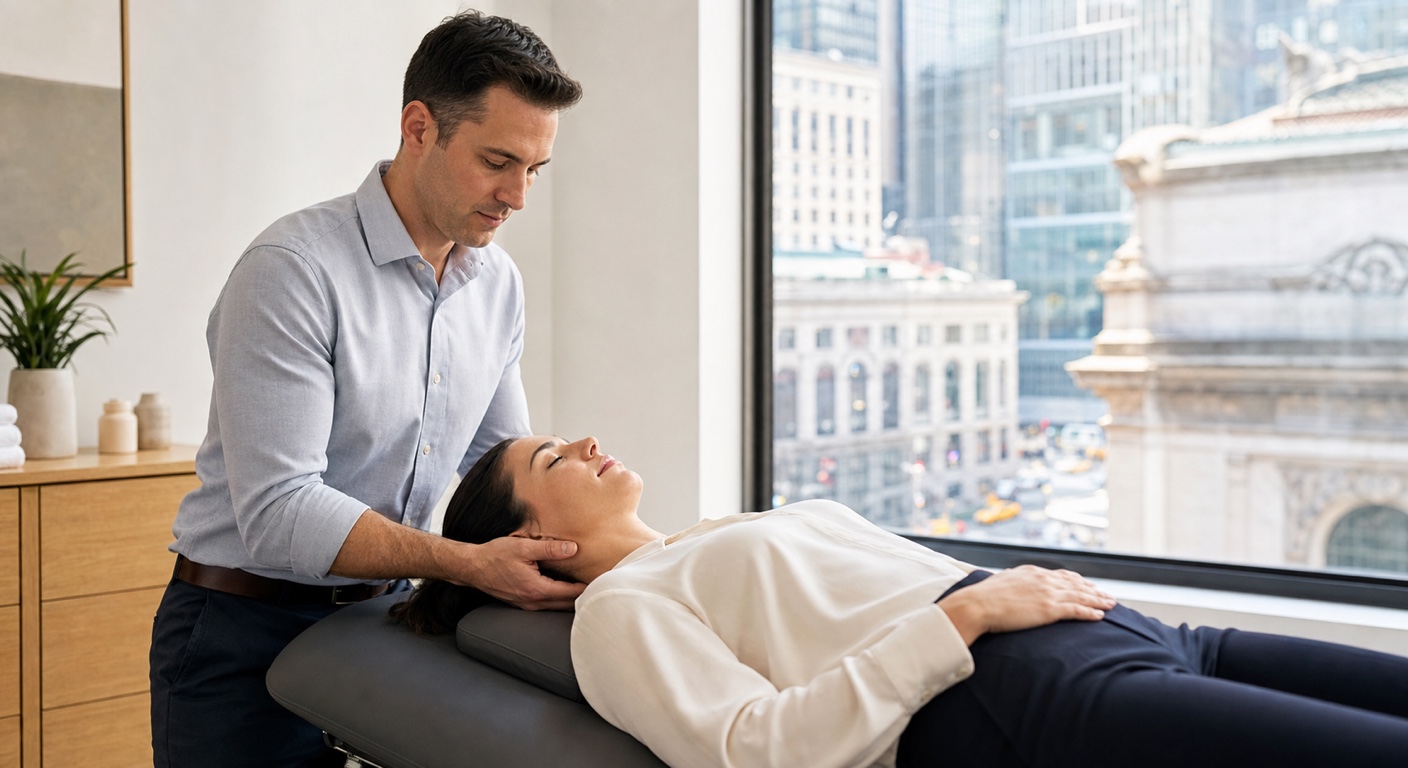
- Chiropractic care — gentle, specific assessment and mobilization of the upper cervical joints that are restricted, restoring normal motion so the suboccipital muscles stop guarding. For many cervicogenic-headache patients this is the single highest-yield intervention.
- Physical therapy — the part that keeps it from coming back. We retrain the deep neck flexors that stabilize your head, strengthen the mid-back and scapular muscles that hold you upright, and rebuild endurance so your posture doesn't collapse by 3 p.m. You'll get a short, realistic program you can run at a desk or in a small apartment.
- Acupuncture — effective for the muscular tension and stress component that feeds these headaches, and a good option for patients who want a drug-free path or who don't tolerate headache medications well. Many Midtown professionals fit a session into a lunch break.
- Therapeutic massage — targeted release of the upper trapezius, levator scapulae, and suboccipital muscles that are actively referring pain, which often brings fast relief while the corrective work takes hold.
We also fix the setup that is re-loading your neck every day: a few minutes of ergonomic guidance on monitor height, chair, and phone habits often prevents the next flare.
When a headache needs more than conservative care
Most desk-driven headaches are mechanical and safe to treat conservatively. But some headaches are not, and it matters to know the difference. Seek prompt medical evaluation rather than routine care if you have a sudden "worst headache of your life," a headache after a head injury, headache with fever and a stiff neck, new neurological symptoms (weakness, slurred speech, vision loss, confusion), a headache that steadily worsens over days to weeks, or a new headache pattern after age 50. When in doubt, get evaluated first.
You don't have to live with the 3 p.m. headache
If your headaches track with your workweek and your neck feels tight and overloaded, that is a treatable pattern — and often a faster fix than people expect once the right joints and muscles are addressed. We have on-site digital X-ray at both locations if imaging is warranted, and we can usually get you evaluated the same week.
Herald Square (38 W 32nd St, Suite 501) and Grand Central (265 Madison Ave, 2nd Floor) — both steps from the subway.