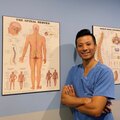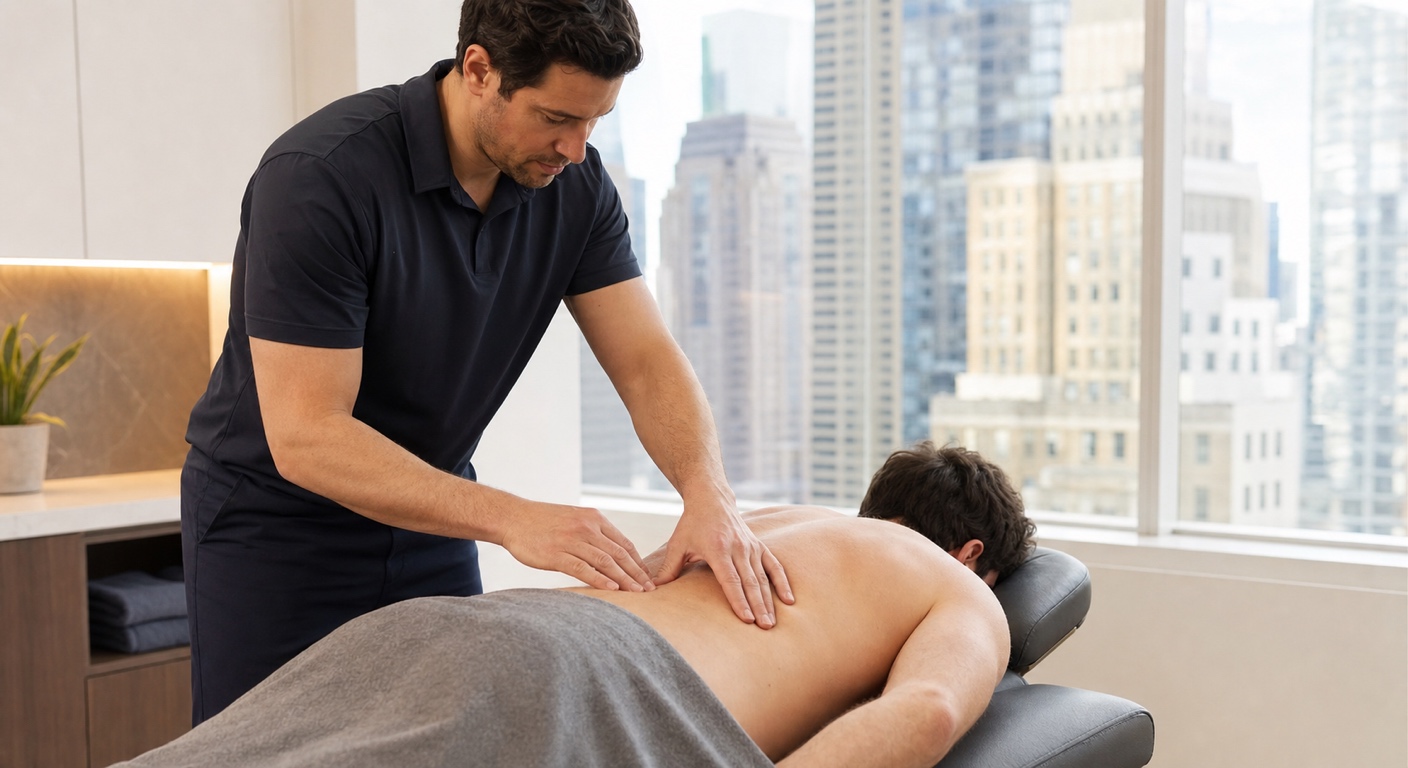
If you've been told you have a herniated disc and a surgeon is already in the conversation, take a breath. Most people with disc herniations — including those causing real pain, leg symptoms, and limited mobility — do not need surgery. At Manhattan Spine & Rehabilitation, with offices at 265 Madison Avenue (Grand Central) and 38 W 32nd Street (Herald Square), we help Midtown patients work through disc injuries conservatively every day.
What a herniated disc actually is
Your spine is stacked with cushioning discs — each one has a tough outer ring (the annulus) and a gel-like center (the nucleus). A herniation happens when that center pushes through a tear in the outer ring and presses against nearby nerves. In the lower back, that pressure often sends pain, tingling, or numbness down into the leg. In the neck, it can radiate into the shoulder, arm, or hand. The degree of herniation — bulge, protrusion, extrusion — affects the approach, but does not automatically mean you need an operation.
Why Midtown desk work and commuting make it worse
- Hours of sustained sitting compresses the lumbar discs more than almost any other position
- Forward-flexed posture at a laptop or phone screen adds load to the front of each disc, exactly where herniations tend to occur
- Carrying a briefcase or heavy bag on one side introduces asymmetric compression over thousands of steps a day
- Tight hip flexors from long commutes tilt the pelvis and increase lumbar lordosis, putting the lower discs under sustained stress
None of these factors cause a herniation overnight, but they reliably prevent one from healing if nothing changes.
How we approach disc herniations without surgery
There is no single protocol — what works depends on which disc is involved, what the nerve is doing, and how long symptoms have been present. After a thorough evaluation, a care plan at Manhattan Spine may include:
- Chiropractic care to restore joint mobility in the segments above and below the injured level, reducing compensatory strain on the disc itself. Adjustments near an acute herniation are modified to be safe and targeted — we work around the injury, not through it.
- Physical & manual therapy to release the muscles guarding the area, restore normal movement patterns, and begin the progressive loading the disc needs to heal. Passive rest alone delays recovery.
- Traction and decompression techniques that create gentle negative pressure in the disc space, encouraging the displaced material to retract and reducing nerve compression.
- Nerve mobilization — specific movements that help the irritated nerve glide freely again rather than staying stuck against the disc or surrounding tissue.
- SoftWave therapy as an adjunct for stubborn cases, particularly where surrounding soft tissue and muscle involvement is prolonging recovery.
What to expect with conservative care
Most patients with acute disc herniations see meaningful improvement within 6–12 weeks of consistent conservative treatment. That timeline can feel long when you're in pain, but it matches how disc tissue actually heals. The critical piece is not just quieting the flare — it's building enough stability and movement quality that the disc doesn't re-herniate the moment you go back to full activity.
We are upfront when surgery should be on the table: a disc causing progressive neurological loss (weakness, bladder or bowel changes, rapidly expanding numbness) needs urgent medical evaluation. That is a small minority of cases. For everyone else, conservative care is the evidence-supported first step — and in the majority of cases, it's all that's needed.
When to stop waiting and get evaluated
If your back or neck pain has been accompanied by any radiating arm or leg symptoms, you've been managing it for more than a few weeks without improvement, or it keeps coming back after short breaks, it's worth getting a real look. Dr. Gary Yen and the Manhattan Spine team will assess the pattern, review any imaging you have, and build a plan grounded in what we actually find — not a generic approach.
Serving Midtown Manhattan — steps from Grand Central and Herald Square.