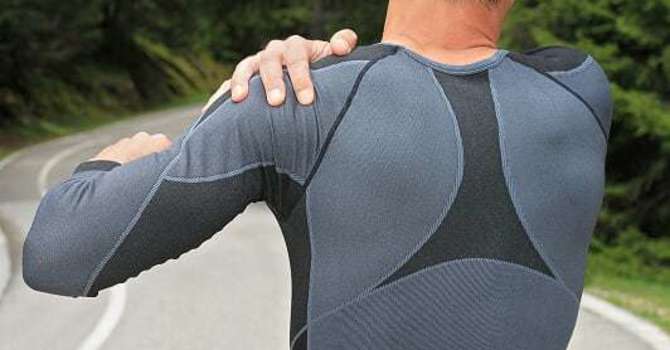
If your shoulder has been aching for weeks — a dull throb when you lift your arm, a sharp pinch when you reach overhead, or a stiffness that starts on your subway commute and follows you to your desk — you are not imagining it, and you are not alone. Shoulder pain is one of the most common complaints we see at Manhattan Spine & Rehabilitation. And in Midtown Manhattan, the daily routine of most working adults creates conditions that accelerate it.
Why NYC office workers are especially vulnerable
A standard Midtown workday stacks the odds against your shoulder. Hours spent at a keyboard round the thoracic spine and pull the head forward, which in turn tilts the shoulder blade out of position. When the scapula tips, the space inside the shoulder joint narrows — setting the stage for impingement every time you lift your arm. Add a subway commute where you grip an overhead bar or hold a heavy bag on one side, and you are loading an already compressed joint repeatedly throughout the day.
The most common shoulder conditions we evaluate in our Midtown patients include:
- Rotator cuff tendinopathy — gradual breakdown of the rotator cuff tendons, most often the supraspinatus, from sustained overhead reaching or forward-shoulder posture at a desk
- Shoulder impingement syndrome — when the rotator cuff tendons get pinched between the humeral head and the acromion during arm elevation
- Biceps tendinosis — irritation of the long head of the biceps tendon, which runs through the shoulder and is commonly aggravated by overhead grip (subway hand straps, reaching into overhead luggage, stock trading postures)
- Frozen shoulder (adhesive capsulitis) — the joint capsule thickens and tightens, progressively limiting range of motion in all directions; often misread as a rotator cuff problem because it also causes night pain and overhead restriction
The commuter contribution
Subway hand straps and overhead bars are a specific shoulder stressor that most commuters never think about. Gripping an overhead bar on a moving train requires sustained isometric work from the rotator cuff and trapezius — and when the train lurches, that load spikes suddenly. Do that for 20–30 minutes twice a day and tendons that are already irritated from desk posture get very little recovery time. Similarly, carrying a heavy shoulder bag or laptop bag on one side trains the upper trapezius to stay braced on that side while the opposite shoulder drops — a pattern that loads the AC joint and upper cervical spine unevenly over months.
How our team approaches shoulder pain
At Manhattan Spine & Rehabilitation, we do not treat shoulder pain as an isolated joint problem. The shoulder is a chain — thoracic spine mobility, cervical mechanics, scapular control, and rotator cuff strength all feed into how the joint loads every time you move your arm. Our approach layers several disciplines:
- Chiropractic care — Dr. Yen and our chiropractic team address the thoracic and cervical dysfunction that alters shoulder mechanics. Improving mid-back mobility and correcting cervical alignment can reduce impingement forces as the scapula settles into a healthier position.
- Physical therapy — targeted rotator cuff and periscapular strengthening restores the dynamic stability the joint depends on. Our PT team programs exercises that fit into real Midtown schedules — not an hour of homework, but focused work that moves the needle.
- SoftWave acoustic shockwave therapy — for tendinopathy that has been present for weeks or months, SoftWave delivers focused acoustic waves directly into the tendon tissue, stimulating the body's repair response. Sessions are brief (10–15 minutes), require no injections, and have no downtime — important when you are walking back to a desk at 265 Madison Avenue.
- Massage therapy — the trapezius and pec minor are almost always braced and shortened in desk workers with shoulder pain. Therapeutic massage releases the tissue that is pulling the shoulder out of alignment and lets the corrective work from chiropractic and PT hold longer.
- Interventional pain management — when a shoulder needs more direct intervention (a corticosteroid injection for acute bursitis, or a guided injection for adhesive capsulitis), our interventional pain management physician can evaluate and coordinate that care in-house. You do not need to be referred out and then wait months for an orthopedist appointment. For frozen shoulder specifically, corticosteroid injection typically provides short-term benefit; repeated injections carry risk, and injection is most effective as an adjunct to active rehabilitation rather than a standalone treatment.
On-site diagnostics — know what you are dealing with before you commit to a treatment plan
One reason shoulder pain drags on is that people treat symptoms without knowing the actual diagnosis. We have digital X-ray and diagnostic ultrasound on-site at our Midtown locations, which means we can image the shoulder during the same visit and see whether the issue is bone, tendon, or joint capsule — and rule out anything that needs a different kind of care. That matters, because frozen shoulder and rotator cuff impingement respond to very different treatments. Treating one like the other wastes months.
When to stop waiting and come in
If your shoulder has been bothering you for more than two to three weeks, has not improved with rest, or is waking you up at night — that is the window where early care prevents a minor tendon issue from becoming a chronic problem. Frozen shoulder in particular becomes significantly harder to resolve the longer it goes untreated; early intervention often avoids the manipulation under anesthesia or surgery that neglected cases can require.
Important: Sudden or severe left shoulder or arm pain — especially when accompanied by chest pressure, shortness of breath, or sweating — can reflect referred cardiac pain and requires immediate emergency evaluation rather than musculoskeletal care.
Two Midtown locations — Herald Square (38 W 32nd St, Suite 501) and Grand Central (265 Madison Ave, 2nd Floor).