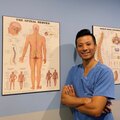
If standing and walking bring on a deep ache, heaviness, or tingling in your legs that eases the moment you sit down or lean forward — over a shopping cart, onto a subway rail, against a wall — there is a good chance you are dealing with spinal stenosis. It is one of the most common reasons older New Yorkers start avoiding the long Midtown blocks and the subway stairs. The good news: many people with stenosis get meaningful relief without surgery, and that is where we start at Manhattan Spine & Rehabilitation.
What spinal stenosis actually is
Spinal stenosis is a narrowing of the spaces inside your spine — the central canal where the spinal cord and nerves run, and the smaller openings where nerve roots exit. As those spaces narrow, usually gradually with age, the nerves have less room and can become compressed. In the lower back (lumbar stenosis), that shows up as back, buttock, and leg symptoms. In the neck (cervical stenosis), it can affect the arms and, in more advanced cases, balance and coordination.
The narrowing itself is often driven by the normal wear-and-tear changes of the spine: thickened ligaments, enlarged joints, disc changes, and bone spurs that slowly encroach on the space the nerves need.
The tell-tale pattern
Stenosis has a signature that helps distinguish it from other causes of back and leg pain:
- Symptoms worsen with standing and walking — the classic "I can only go a block or two before my legs give out"
- Symptoms ease with sitting or bending forward — leaning over a cart or counter opens up the space and relieves the pressure, sometimes within a minute
- Heaviness, cramping, or tingling in the legs rather than one sharp, localized pain
- Often both legs, though it can be worse on one side
That flexion-relief pattern is why people with stenosis often say they can walk much farther pushing a shopping cart, or ride a bike without trouble even when walking is difficult.
Why Midtown makes it obvious
This city stress-tests a stenotic spine. Long avenue blocks, subway stairs, standing on the platform, and walking to and from Grand Central and Herald Square all load the spine in extension — the exact position that closes down the space around the nerves. Many patients first notice the problem not because it appeared suddenly, but because their daily Midtown commute demands more standing and walking than the spine can comfortably supply.
How we approach it
Surgery is sometimes necessary for stenosis, but it is rarely the first step, and many patients do well with a conservative plan. At Manhattan Spine, care for stenosis focuses on creating more room and tolerance around the affected nerves and improving how you move so you can do more before symptoms start:
- Chiropractic care and manual therapy aimed at improving mobility in the segments above and below the narrowed level, so the stenotic area is not forced to absorb every movement
- Flexion-based rehabilitation — targeted exercises that use the positions which relieve your symptoms to build walking tolerance and core support
- Soft-tissue and physical therapy work to address the tight hip flexors and guarded muscles that pull the low back into the extension position that provokes symptoms
- Activity and pacing strategies — practical adjustments to how you walk, stand, and navigate the city so you stay active without repeatedly flaring the nerves
Part of good care is also knowing when to refer. If we see signs that point beyond conservative management — progressive weakness, or any change in bowel or bladder function — we coordinate promptly with the right expert. Those red-flag symptoms are uncommon, but they matter, and a proper evaluation screens for them.
What you can do starting today
- When symptoms build while walking, sit or lean forward for a minute to let them settle rather than pushing through
- Break long walks into shorter segments with brief rests — you will often cover more total distance
- Try gentle knees-to-chest or seated forward-bend stretches, which open the space around the nerves
- Keep moving overall — inactivity stiffens the spine and weakens the muscles that protect it
These strategies help you manage day to day, but they do not change the underlying mechanics on their own. A proper evaluation identifies exactly which levels are involved and which positions and movements help versus hurt — and that is what a real plan is built on.
Dr. Gary Yen and our Midtown team evaluate and treat spinal stenosis regularly. If walking the city has quietly gotten harder, it is worth finding out what is driving it and what non-surgical options fit your case.
Convenient for Grand Central & Herald Square — 265 Madison Ave, 2nd Floor.